
Cook County Arrest Warrants Explained
Judicial review comes first. A judge or magistrate weighs sworn facts. Probable cause is the standard. It means the facts reasonably show that an offense occurred and that the named person committed it. Only after that review does an arrest warrant authorize taking someone into custody. Cook County Magistrate Court handles pre-warrant application hearings and nearly all criminal warrants, which makes it the main public contact for many county warrant matters. Issuing and serving are separate jobs. The judge controls issuance and any later court action. The Cook County Sheriff executes county process and can address accessible status or custody routing. Superior Court of Cook County, Alapaha Judicial Circuit handles felony criminal matters. April Garrett, Clerk of Superior Court, keeps the related court files. That is why a status call and a court-record request may answer two different questions.
Start a Cook Arrest Warrant Check
Cook County publishes no official arrest-warrant database. Call the Cook County Sheriff's Office at (229) 896-7471 instead. Ask staff whether a phone self-check is allowed. Have the exact legal name, date of birth, known agency, approximate date, and any case or warrant number ready. The sheriff site routes callers through office and jail extensions rather than a dedicated warrant line.
- Ask if the record is active, served, recalled, transferred, sealed, or too recent to post.
- Request the issuing court, case or warrant number, status date, and next step.
- Call Magistrate Court at (229) 896-3151 for application, hearing, or bond routing.
- For a superior criminal case, call the Superior Clerk at (229) 896-7717.
- Write down the office, date, instructions, and promised follow-up.
Key point: Georgia.gov warns that an in-person warrant check may lead to custody if an active warrant is found.
Inside a Cook County Arrest Warrant
A reliable warrant record shows its jurisdiction, its source, and its update date. Cook County publishes no sample number format. Use the number exactly as staff gives it. Some material, including protected investigation facts and juvenile records, may stay closed to general inspection.
| Warrant or Application Number | The exact identifier used by court and sheriff staff, such as number on file. |
|---|---|
| Named Subject | Legal name and identifiers used to separate similar records. |
| Charge or Statute | The alleged legal category, not a judgment of guilt. |
| Issuing Court | The judicial office that controls the warrant and any later recall. |
| Bond or Release Field | Terms set by a judge, or blank until judicial review. |
| Dates and Status | Issue date, status date, service return, and next court event when public. |
Cook Warrant Notice Changed in 2026
The official Georgia legislation page records the 2026 warrant-application notice measure.
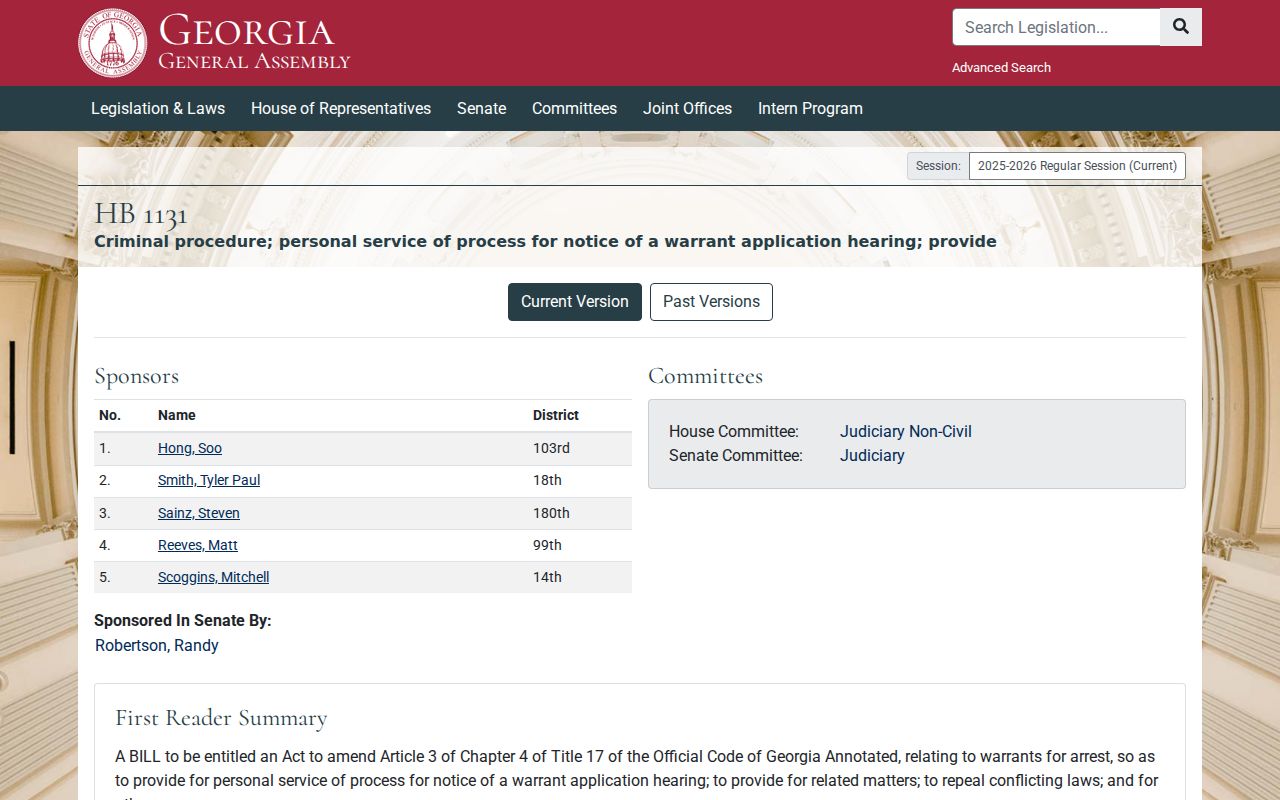
Georgia's legislature rewrote part of its warrant-application hearing notice law, a change that reaches Cook County proceedings. The vehicle was signed HB 1131. It took effect July 1, 2026. The new language calls for personal service or another approved method reasonably calculated to inform the person in the warrant-application hearing setting. For bill status and effective-date context, the official legislation record is the place to look. The bill history documents procedure, not a public warrant result. Notice is not guaranteed for every arrest warrant. Procedures vary with the application type, the court, and the facts. Ask Cook County Magistrate Court whether the notice provision applies to the specific proceeding. Old emergency orders from 2024 and 2025 set no current deadlines. Both were temporary and expired.
Serving Arrest Warrants in Cook County
The Cook County Sheriff serves or executes county process and handles custody, jail, and court-security routing. Municipal police may act on city matters as authorized. Serving a warrant does not give that agency control over the court record or the power to recall it. The issuing judge controls judicial status. That split is why a sheriff call should be paired with a court confirmation when exact docket history or relief is needed. After execution, the service or return field may show what happened, if that information is public. Next steps can include booking, an initial appearance, bond review, and a scheduled court event. Cook County Magistrate Court lists bond hearings and bond setting. But it publishes no universal local bond schedule or surrender appointment process. Ask which office handles custody. Ask whether bond has been set. Never infer terms from a blank online field.
Restricted Cook Arrest Warrant Records
Georgia's Open Records Act opens many records to inspection and copying, but it carries exemptions. Pending investigative material may be withheld. Georgia Superior Court Rule 21 also recognizes limits on protected or sealed information. Cook County's clerk states that juvenile records are not generally available to the public. So a missing detail can mean restricted access, not that no warrant exists. For historical material, send a narrow request to the proper custodian. Name the court, record type, date range, case number, and non-exempt fields you want. Cook County's form spells out the fees. Copies generally run $0.10 per page. The first 15 minutes of qualifying labor are free. Later labor uses the lowest-paid qualified employee's rate. A denial should cite its legal basis, and an Open Records request never replaces a current sheriff status check.
Comparing Cook County Arrest Warrants
These court instruments are not interchangeable. An arrest warrant rests on lawful process tied to an alleged offense. A summons just directs a person to appear. It skips the initial custody command. A bench warrant usually follows a missed appearance or a failure to obey a court requirement. Cook Probate expressly uses "bench warrant" for traffic failure to appear, and more detail sits in the Cook County bench warrant search reference.
| Feature | Arrest Warrant | Summons | Bench Warrant |
|---|---|---|---|
| What It Orders | Custody | Appearance | Custody for a missed duty |
| Basis | Probable cause or lawful process | Notice of a case | Failure to appear or comply |
| Issuer | Judge or magistrate | Court or authorized officer | Judge in the pending case |
| Response | Counsel, surrender, bond, court | Appear as directed | Ask about recall, reset, or appearance |
Sheriff Status Versus Cook Court Files
Two different questions get asked here. A status call asks whether the Cook County sheriff can confirm an executable warrant right now. A court-file request asks what docket entries and public documents the clerk actually holds. The answers can disagree at the same moment, because service, return, transfer, and recall entries move through separate offices. So do not stop at whether a name appears anywhere. Ask for the issuing court, the exact identifier, the current status, and the status date. The Georgia Sheriffs Association directory lists the Cook County agency ORI, phone, and unit information; an ORI is an agency identifier, not a search tool, and its staffing data is not a live caseload count. Cook County publishes no current arrest-warrant total. For aggregate context, a focused request for non-identifying counts beats collecting names.
If There’s a Cook Arrest Warrant
Confirm the record before you decide what to do. Get the issuing court, the status, the warrant number, the alleged charge, and any bond or appearance instruction. Then talk with an attorney about a voluntary surrender, a bond hearing, or a motion asking the court to recall or quash the warrant. Recall means the court withdraws it. Quash means the court sets it aside. Only the court can grant that relief. No official Cook County source publishes a universal recall form, filing fee, same-day process, bond table, or surrender schedule, so do not guess. A lawyer may arrange an appearance or filing and help you plan for medication, transportation, childcare, and the possibility of custody. Afterward, get a docket entry or other written proof and ask the sheriff to confirm the updated status.
Important: Speak with counsel before appearing. An active warrant can result in custody during an in-person check or other police contact.
Confirming Cook Warrant Resolution
A court action is not done until the record shows it. Ask the issuing clerk for a filed recall order, docket entry, disposition, bond document, or other written proof matching the case number. Then ask the sheriff whether its accessible status has updated. Write down the date and office for both checks. A receipt from a private vendor, an email request, or a verbal statement from an unrelated office does not establish that a Cook County arrest warrant is no longer executable. If an arrest record remains after the case ends, Georgia Courts provides separate information on record restriction under O.C.G.A. § 35-3-37 for qualifying circumstances. Restriction is not erasure, and eligibility depends on the record and disposition. The state material references a $25 GBI fee, but that process is distinct from warrant recall. Resolve the warrant and case first. Then seek legal advice about any later record-restriction question.